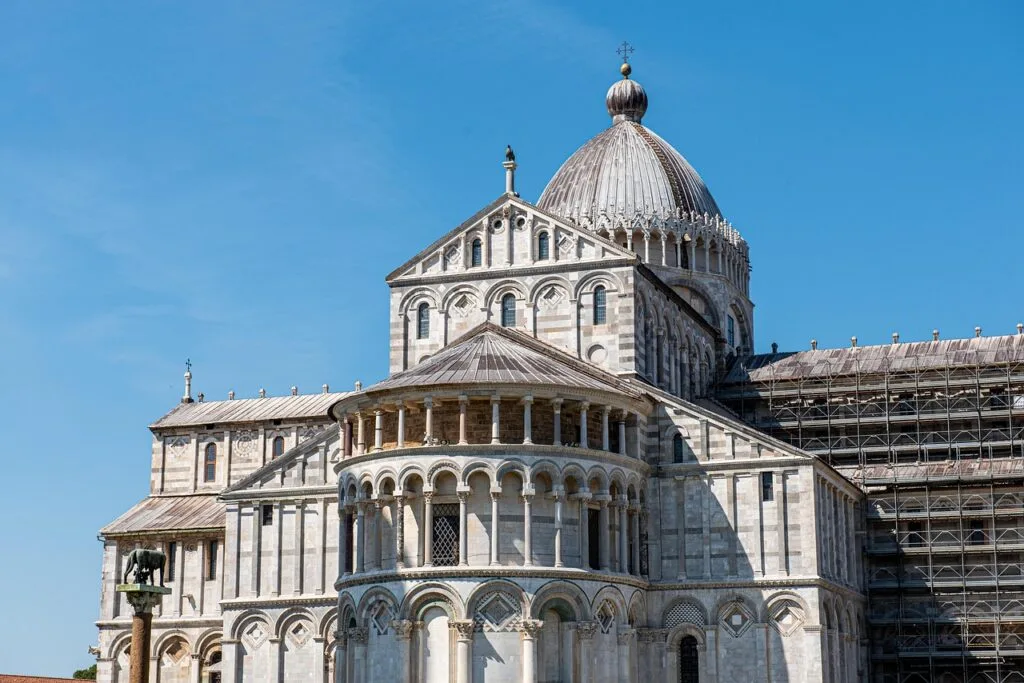






Introduction — Lucca and the poetry of church facades
Lucca (Italian: Lucca), a compact Tuscan town with its charm intact, is an open‑air urban museum where every cobbled lane seems to lead to a new discovery. Among the treasures that punctuate this historic landscape, the church facades hold a special place: they tell stories of faith, rivalry, craftsmanship and history. Here, religious architecture doesn’t just play a sacred role; it proclaims itself as a public manifesto, a stone theater where mosaics, polychrome marble, lively bas‑reliefs and bell towers meet the sky.
Strolling through Lucca is like reading a library of façades: Romanesque restraint sits beside medieval exuberance, Lombard decoration flirts with Renaissance elegance. A church’s façade is often a visitor’s first visual contact—a carved ID card that sets the tone before you step into the cool shadow of the choir. The religious façades of Lucca aren’t merely pretty; they’re narrative, revealing Mediterranean trade and artistic influences, local devotions (particular saints, gospel episodes) and sometimes the civic display of old patrician families.
This article will walk you past Lucca’s most emblematic façades: the majestic Cattedrale di San Martino (Duomo di San Martino), the spectacular and instantly recognizable Chiesa di San Michele in Foro (Saint Michael in the Forum), the trompe‑l’oeil golden front of the Basilica di San Frediano, plus other sacred faces like San Paolino, San Francesco and a few lesser‑known gems. For each building you’ll find the exact address, typical opening hours, entrance or visit prices, an immersive description to help you picture the façade and its surroundings, and practical tips — where to stand for the best photos, when to avoid the crowds, which guided tours to favor, and useful amenities to know about.
Prepare for a sensory route: the play of shadow on marble at dawn, the patina of mosaics in the golden hour, the rattle of bikes over the cobbles reminding you that Lucca is also a living town. The religious façades here are not frozen relics but meeting points between the sacred and everyday life. Whether you’re a photographer, a lover of sacred art, a curious traveler or a modern pilgrim, each façade offers a unique—and often free—experience to be savored slowly.

The Cattedrale di San Martino (Duomo di San Martino)
Full name: Cattedrale di San Martino (Duomo di San Martino)
Address: Piazza San Martino, 55100 Lucca LU, Italy
Price: Cathedral entry is free; Museo del Duomo / Tesoro (treasury): generally €5–€7 (rates vary with temporary exhibitions)
Hours: Cathedral: typically 08:30–12:30 and 16:00–19:00; Museo del Duomo: 10:00–17:00 (closures can vary in low season). Always check hours on arrival, especially on religious feast days.
The façade of the Cattedrale di San Martino is a polyphonic masterpiece: stacked loggias, columns with finely carved capitals, and bands of white and grey marble that give the wall a rhythmic reading. At the center, the famous bas‑relief of the “Volto Santo” and the large portico testify to Marian and Martinian devotion. As you get closer you’ll notice the delicate details: attic cherubs, vegetal arabesques and decorated consoles. The façade plays with depth—niches and arcades follow one another and invite the eye to climb toward the campanile.
Inside, the contrast can be striking: muted light reveals altarpieces, frescoes and the famous Volto Santo, a crucifix‑relic venerated since the Middle Ages (the relic is viewable in the treasury at certain times). Savvy visitors should pair the façade visit with the Museo del Duomo to admire medieval works and liturgical garments. The best photos of the façade are taken from Piazza San Martino in the early morning, when tourists are few and the side light enhances the reliefs.
- Photo tip: stand slightly to the left of the main entrance to capture the arcades in perspective and avoid harsh noon shadows.
- Practical tip: check mass times to avoid disturbing services or finding the church closed to visitors during worship.
- Accessibility: the main entrance is usually accessible, but some museum areas may have steps; plan an alternate route if needed.
 Click here to book a guided tour of San Martino and San Frediano
San Michele in Foro — the façade of the civic heart
Full name: Chiesa di San Michele in Foro
Address: Piazza San Michele, 55100 Lucca LU, Italy
Price: Free entry (donations recommended); paid guided tours around €3–€5 depending on the operator
Hours: Generally open 09:00–19:00 (hours vary with season and services).
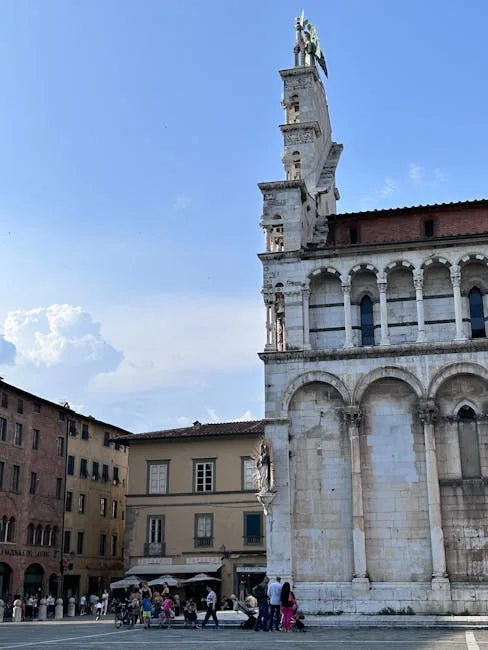
San Michele in Foro surprises with an almost theatrical façade: stacked polychrome arcades and a multitude of sculptures that animate a continuous sculpted scene. Dominating the square, the large Saint Michael vanquishing the dragon has placed the building at the center of civic and commercial life for centuries. The façade, rich in colonnettes and figurations, is a fine example of Luccan Romanesque‑Gothic whimsy. The whole captures light in changing ways: late afternoon reliefs warm to hues that make the stone seem to breathe.
San Michele’s façade is ideal for lovers of lavish ornamentation: angels, narrative figures and geometric motifs follow one another. Take time to decipher the small details—biblical scenes, heads of mythical creatures, symbols of old trades—each a clue to the society that funded and adorned the church. Photographers will find great spots on Piazza San Michele, which frames the façade without major obstructions, but the square can fill up quickly at peak times, especially mornings during the weekly market.
- Practical tip: arrive between 10:00 and 11:30 to avoid harsh light and the influx of day‑trippers from Pisa or Florence.
- Cultural tip: join a local guided tour to understand the carved symbols—guides often share anecdotes about the patrons.
- Photos: favor a moderate wide‑angle lens (24–35 mm) to keep the sculptures readable without distorting perspective.
Click here to discover Lucca’s highlights on foot
Basilica di San Frediano — golden mosaic and popular history
Full name: Basilica di San Frediano (Basilica di San Frediano)
Address: Piazza San Frediano, 55100 Lucca LU, Italy
Price: Free entry; small donations or guided‑tour contributions: €2–€5
Hours: Generally 08:30–12:30 and 15:00–18:30; hours vary in summer/shoulder seasons.
The Basilica di San Frediano is instantly recognizable thanks to its large golden mosaic that decorates the upper façade. Depicting the Ascension or a scene of Christ in glory depending on interpretation, this mosaic is a strong city symbol and a rare example of Byzantine‑medieval decoration still visible in Tuscany. Below it, stone and marble show a more restrained but no less expressive treatment: blind arcades, colonnettes and a rich alternation of volumes.
The mosaic catches the light and feels almost magical at sunset, when it seems to ignite. The interior, spare and harmonious, completes the experience: ornamented chapels, sculpted baptismal fonts, frescoes and a venerable crucifix. Visitors appreciate the basilica’s popular character: it has served as an active parish for centuries and keeps a living connection with locals. Piazza San Frediano beside it is full of cafes and small artisan shops, making it a perfect spot to rest after admiring the façade.
- Photo tip: for great shots, stand on Piazza San Frediano at dusk to take advantage of the warm tones on the mosaic.
- Local tip: if you’re after a good coffee afterwards, head to via Fillungo or the corner of the piazza.
- Historical tip: ask staff or grab a brochure pointing out the mosaic’s historical episodes—often tied to maritime reconquest and trade exchanges of the era.
Click here to join a private tour with a qualified guide
Other façades not to miss: San Paolino, San Francesco and small gems
Beyond the three major monuments, Lucca hides other church façades worth a detour. Among them, the Oratorio di San Paolino and the Chiesa di San Paolino (Piazza San Paolino, 55100 Lucca LU) offer a harmonious, understated front, typical of the constraints of the historic center. The church of San Francesco (Piazza San Francesco, 55100 Lucca LU), more austere, plays with Gothic volumes and a sobriety that contrasts with more ornate façades.
Full name: Chiesa di San Paolino
Address: Piazza San Paolino, 55100 Lucca LU, Italy
Price: Free entry (donations)
Hours: Often 09:00–12:00 and 16:00–19:00 (confirm on site).
Full name: Chiesa di San Francesco
Address: Piazza San Francesco, 55100 Lucca LU, Italy
Price: Free entry (some areas may be ticketed for temporary exhibitions)
Hours: Often 09:00–18:00 (variable).
These façades, though less famous, let you appreciate stylistic variations: Franciscan restraint, discreet Baroque ornaments, well‑preserved medieval portals. They’re perfect for those seeking a more intimate experience away from the main tourist flows. Wander the adjoining lanes and you’ll come across carved brackets, commemorative plaques, and sometimes artisan workshops where stone and wood are still worked using age‑old techniques.
- Discovery tip: bring a small map or use an offline mapping app—these churches are often tucked into narrow lanes where mobile signal can be patchy.
- Practical tip: always check noticeboards at the entrance; schedules and parish activities can temporarily limit access.
- Suggested route: start at the Duomo, pass San Michele in Foro, follow via Fillungo toward San Frediano, then explore the western streets to find San Paolino and San Francesco.
Click here to book a 2‑hour walking tour of the city center

Conclusion — Read the stone to understand Lucca
Lucca’s religious façades are more than decorative finishes: they are open books on the identity of a city that blended faith, civic power and art. Each façade tells of an era, a patron, a style and a relationship between the sacred and the public. The Duomo di San Martino raises questions with its architectural layering and treasures, San Michele in Foro fascinates with its sculptural abundance, San Frediano impresses with its golden mosaic, and small sanctuaries like San Paolino offer the sweetness of an intimate discovery.
For the visitor, the key is slowness: take time to look, read inscriptions, notice details that, along the streets, compose a mosaic of stories. Respect places of worship and times of prayer, contribute if you can with a small donation and, if you love photography, favor off‑peak hours (early morning or late afternoon) to get images that are both beautiful and respectful.
Finally, think of Lucca not as a checklist of objects but as a sensory itinerary: the stone, the light, the hush of a chapel, the chant of a service drifting from an open window. The façades are only the threshold; step through to discover the interiors and the human stories that keep this Tuscan town’s heart beating.
Click here to book a private guided walking tour