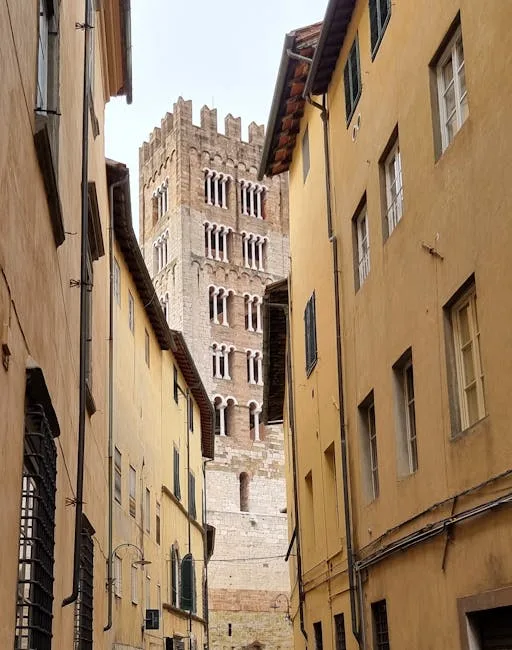





Introduction — A Deep Dive into Lucca’s Medieval Palaces
Lucca (Lucca in Italian) is a Tuscan town that looks like it stepped out of a painting: intact city walls, cobbled lanes, shaded squares and an astonishing concentration of palaces and towers that tell the city’s medieval and aristocratic story. This architectural route offers an in-depth look at the civic palaces and buildings that shaped Lucca from the Middle Ages through the Renaissance. The goal is to combine history, architecture and sensory experiences — to feel the stone, hear the bells, climb towers and wander hidden gardens — so you can understand how these places functioned as homes, seats of power and displays of family prestige.
Lucca preserves a rare urban continuity: its 16th-century walls form a green frame, and within them courtyards and historic façades follow one another almost without interruption. The medieval palaces we describe are more than façades; they are spatial complexes made up of courtyards, grand staircases, reception rooms, frescoes, carved portals and sometimes secret gardens. Walking this route, you will learn to read the city like an architectural book: spotting defensive features that became decorative, distinguishing Lombard, Pisan or Florentine influences, and seeing how the stone tells stories of conflicts, marriages and patronage.
Through the sections ahead we’ll focus on iconic sites — the Torre Guinigi and the Palazzo Guinigi complex, the baroque garden and theatrical interiors of Palazzo Pfanner, and the imposing Palazzo Ducale di Lucca — giving each one’s exact address, typical opening hours, current admission prices in euros, an immersive description and local practical tips to make the most of your visit (best times, ticket combinations, transit and footwear recommendations). Visual cues sprinkled throughout will help you imagine the scenes: façades lit by the setting sun, staircases seen from above, hanging gardens, carved portal details and viewpoints from the ramparts.
This guide is made for the curious traveler: it provides not only practical info but suggestions to extend your walk nearby — a stop for coffee on a terrace, a complementary visit to a nearby church, or directions to reach the Piazza dell’Anfiteatro from a given palace. Lucca lends itself to slow discovery; pack comfortable shoes, a sketchbook for notes and a bit of time to simply sit and admire the layering of eras. Now, let’s start from the leafy heights of the Torre Guinigi and descend into the courtyards and salons of the palazzi.
Torre Guinigi and Palazzo Guinigi — the tower-garden at the medieval heart
The Torre Guinigi is arguably the most emblematic image of Lucca. Perched atop a medieval tower, a small Holm oak garden crowns the skyline, standing out against the Tuscan sky. Address: Via Sant’Andrea, 1, 55100 Lucca LU, Italy. The tower is part of the complex commonly called Palazzo Guinigi, a seat of a noble family from the late Middle Ages. The tower dates from the 14th–15th centuries and symbolizes the rivalry between powerful families who built towers and palaces as status symbols.
Immersive description: approaching Torre Guinigi you’ll notice the weight of limestone under your hand, hear footsteps echo on the cobbles and see the narrow perspective of Via Sant’Andrea open suddenly onto the tower’s vertical mass. The entrance leads to a characteristic spiral staircase found in defensive structures, each worn step telling generations of lives: soldiers, lords, servants and visitors. At the top, the hanging garden provides a rare sensory experience: the resinous scent of the holm oaks, sweeping views over Lucca’s red roofs and the distant bell tower of the Cattedrale di San Martino.
Hours and fees (indicative; check before visiting): Torre Guinigi is generally open daily; typical hours: 9:00–19:00 (longer in summer, earlier close in winter). Admission: about €5.00 for adults; reduced rate €3.00 for students and seniors; children often free or discounted. Payment usually accepted in cash and by card at the ticket office.
Practical tips: climb early in the morning or late afternoon to avoid crowds and get warm light for photos. The staircase is narrow and not suitable for strollers or people with reduced mobility — allow roughly 20–30 minutes for ascent, exploration and descent. Use the visit to explore the adjacent streets and pop into the small church of San Frediano in Corte a few steps away, or head over to Piazza San Michele. For a more in-depth experience, book a local guide or an audio guide on site.
 Click here to book a private Lucca tour with a qualified guide

Palazzo Pfanner — a baroque garden and theatrical interiors
The Palazzo Pfanner is famed for its baroque garden and its theatrical interior staging that evokes the life of a noble family from the late 17th to the 19th century. Address: Via degli Asili, 33, 55100 Lucca LU, Italy. Although the current façade largely dates from later centuries, the structure rests on older elements and the site’s continuity makes it a must-see to appreciate the transition from medieval style to later remodellings.
Immersive description: entering through the gate you’re immediately struck by the balance of the formal garden — parterres, fountains and topiary — designed to be admired from the salon windows. Inside, wood-paneled rooms, frescoes and a collection of medical and musical instruments narrate the families’ history and domestic uses. The atmosphere is that of a house-museum where every object, tapestry and painting contributes to a social and cultural reading of the place.
Hours and fees (indicative): Palazzo Pfanner typically opens from 9:30 to 18:30 in high season (April–October) and 10:00–16:00 in low season; closed on some public holidays. Admission: about €6.00 for adults; reduced €4.00; free for very young children. Combined tickets are sometimes available with other municipal museums.
Practical tips: the garden is especially photogenic at dawn, when the dew highlights the topiary. The palace interior is often cooler than outside — bring a light jacket in winter. Garden history enthusiasts should take time to read the explanatory panels and locate the central fountain, often adorned with allegorical figures. If you’re traveling with a group, check for the possibility of a specialist guided tour on the history of the collections and the palace’s evolution over the centuries.
Click here to book a private guided walking tour of Lucca
Palazzo Ducale di Lucca — seat of power and overlapping architectures
The Palazzo Ducale di Lucca (often simply Palazzo Ducale) is a major building for understanding how power was represented in Lucca. Address: Piazza Napoleone, 55100 Lucca LU, Italy. The palace occupies a central square and combines medieval, Renaissance and later remodelling elements that reflect political ups and downs — from local governance to periods of foreign rule.
Immersive description: crossing the Palazzo Ducale’s threshold is like stepping into a maze of vast rooms, inner courtyards and monumental staircases. The façades facing Piazza Napoleone convey civic assertion; the interior rooms, often hosting temporary exhibitions or cultural institutions, retain traces of ornamentation and ceremonial use. You feel the historical layers: beneath baroque moldings, the medieval urban fabric persists.
Hours and fees (indicative): depending on the part of the palace you visit (temporary exhibitions, public rooms), opening times vary — generally open Tuesday to Sunday, 10:00–18:00; closed Monday. Fees vary: permanent access or public rooms often free, temporary exhibitions paid between €5.00 and €12.00. Check the official site for current events and exact times.
Practical tips: Piazza Napoleone was once the civic and military heart; observe the alignments and imagine public ceremonies. If a temporary exhibition interests you, buy tickets online in high season to avoid queues. The palace is well connected to nearby attractions: the Cathedral of San Martino and the Casa di Puccini lie just minutes away for a deeper cultural dive. For architectural photography, aim for morning light on the south façade for softer illumination.
Click here to book a walking tour of Lucca’s historic center
Practical route and local tips for visiting Lucca’s palaces
Planning your route in Lucca needs a bit of logic: favor proximity between sites, account for varying opening hours and set realistic visit lengths. A full-day itinerary might be: start at the Torre Guinigi (Via Sant’Andrea, 1) at sunrise to beat the crowds, descend toward the Piazza San Michele and wind through the small medieval streets, visit Palazzo Pfanner (Via degli Asili, 33) mid-morning (ideal for the garden), have lunch at the Piazza dell’Anfiteatro, then spend the afternoon at the Palazzo Ducale (Piazza Napoleone) and the exhibition rooms. This sequence leaves room for coffee breaks and helps manage opening hours.
Transport and access: Lucca’s historic center is largely pedestrian; it’s best to park at one of the peripheral lots (e.g., Parcheggio Piazza Napoleone or Parcheggio LAMPO) and continue on foot. The city walls provide excellent walking links and transition points to reach the palaces. If arriving by train, Lucca station is about a 20–25 minute walk to the center; city buses and taxis are also available.
Comfort tips: wear comfortable shoes for cobbles and stone staircases; bring a reusable water bottle (public fountains often provide potable water); sun hat and sunscreen in summer, and a light jacket in spring/autumn as palace interiors can be cool. Photographers should bring a wide-angle lens for interiors and a telephoto for isolating carved details. For tower visits, avoid bulky bags and prefer a lightweight daypack.
Tickets and discounts: many monuments offer reduced rates for students, seniors and groups. Ask about combined tickets (civic museums) which can save a few euros if you plan multiple visits. Lucca’s tourist offices (Pro Loco Lucca) and info points at the train station or Piazza Napoleone provide brochures with exact addresses, updated hours and current events.
Click here to book a private day trip to Pisa and Lucca

Conclusion — Between stone and memory: extending the visit
Lucca reads like a palimpsest: each palace, tower and courtyard concentrates social and architectural memory. Visiting Torre Guinigi, Palazzo Pfanner and the Palazzo Ducale, you explore not just buildings but narratives of power, prestige and daily life. These sites offer rich contrasts — the surprising vegetation crowning a tower, the geometric order of a baroque garden, the solemnity of a civic palace — composing a full experience of medieval and post-medieval architecture.
To extend your exploration, I recommend pairing visits with stops at local artisans (pastry shops and coffee roasters in the alleyways), listening to sacred music at the Cattedrale di San Martino, and taking a twilight walk along the ramparts for panoramic views of red roofs and distant hills. Note that practical details (hours, prices) change: check official websites or Lucca’s tourist office before you go. Finally, allow yourself to get lost on purpose: often the richest discoveries lie off the beaten path — a hidden façade, a small commemorative plaque, a private courtyard open by chance.
Click here to book tickets for a Puccini Festival concert
All in all, this architectural itinerary invites a slow, attentive exploration where beauty lives as much in carved details as in the layering of uses through the centuries. Bring your curiosity; Lucca reveals itself to those who let the city set its own pace, between shadow and light, stone and foliage.